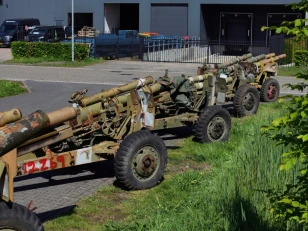
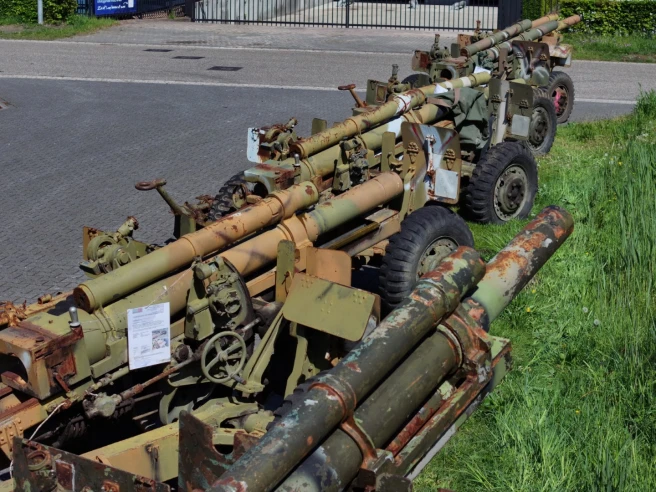


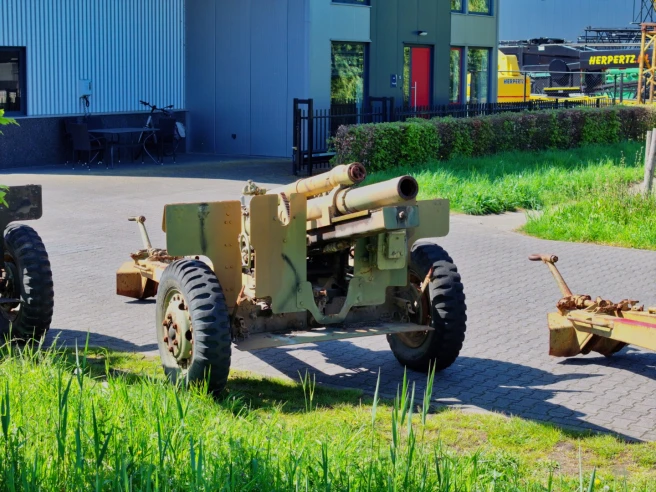


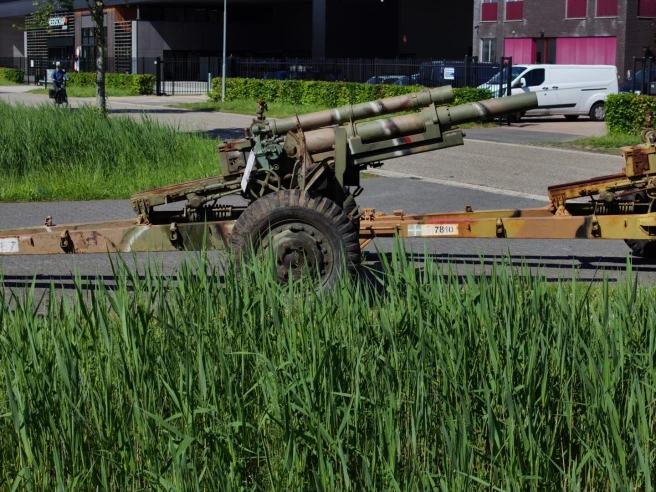


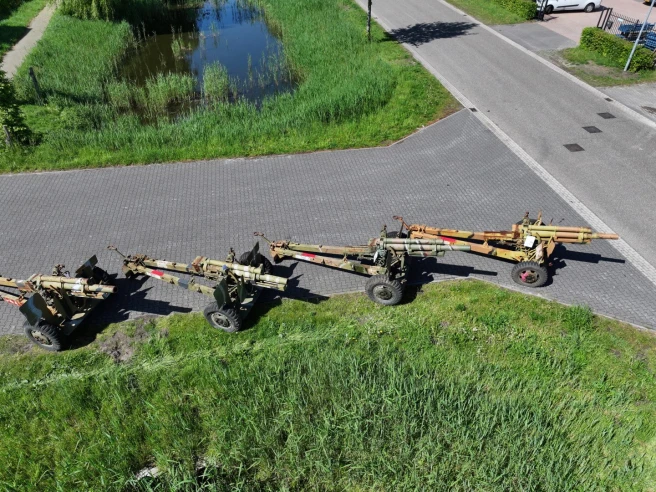
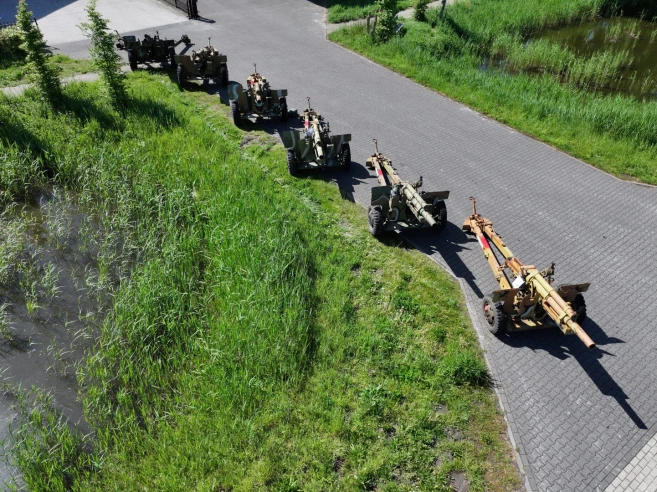
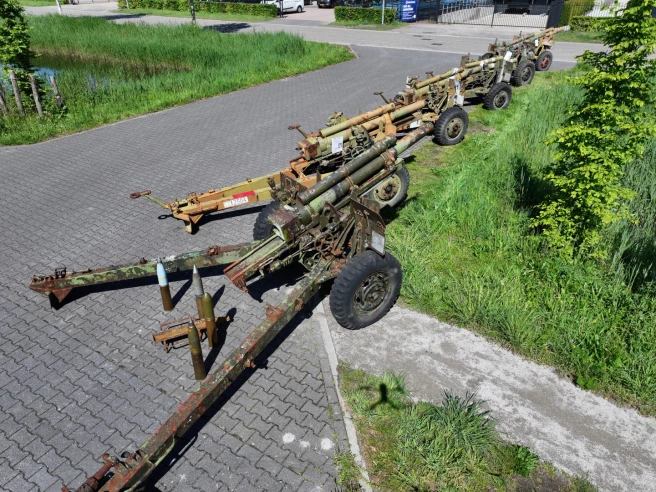
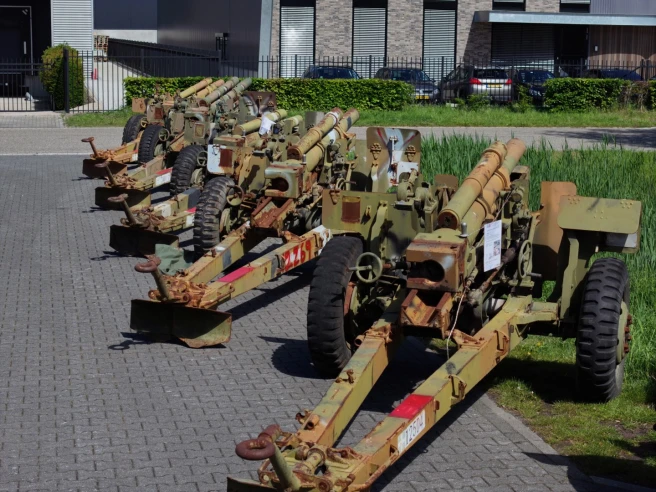
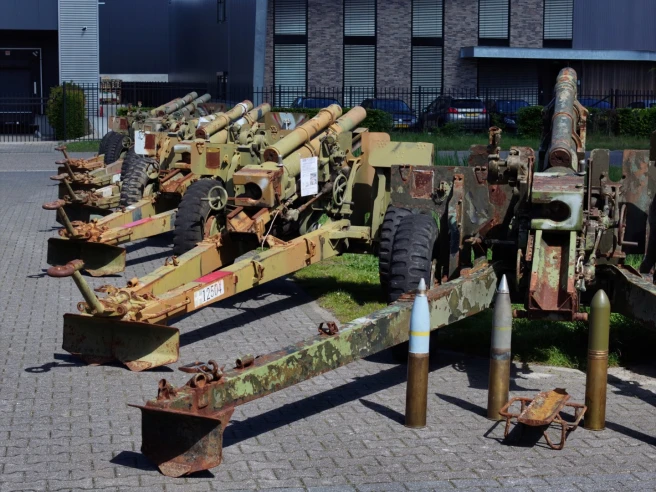
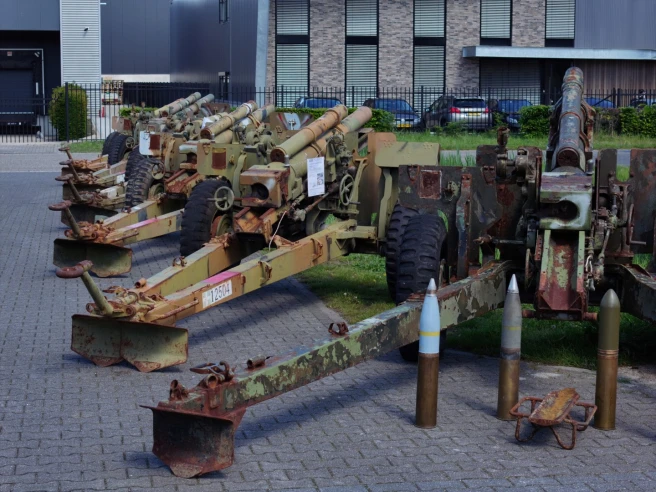




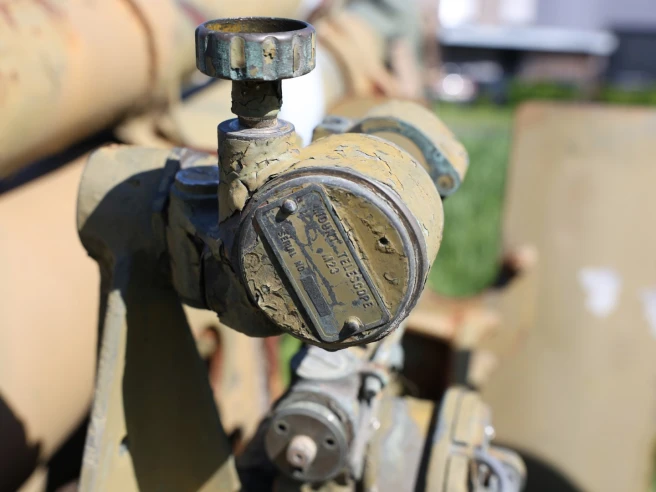

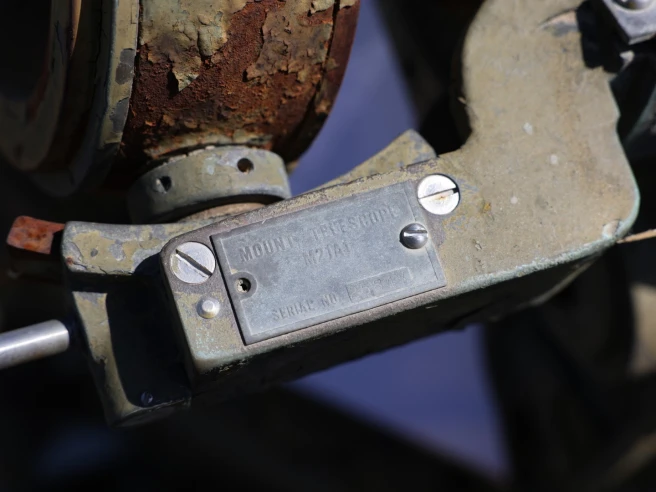

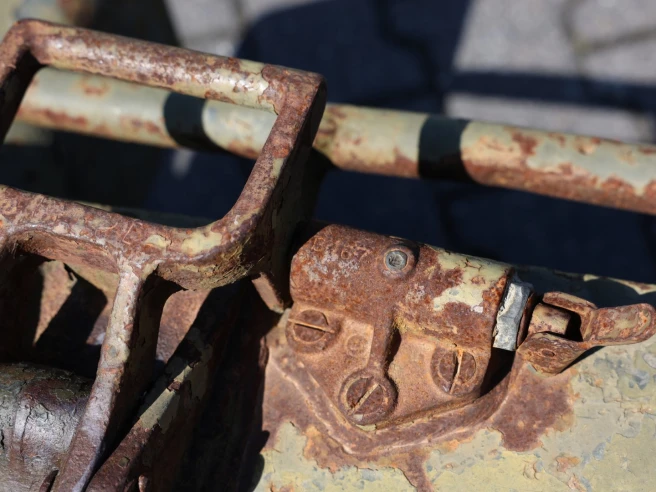
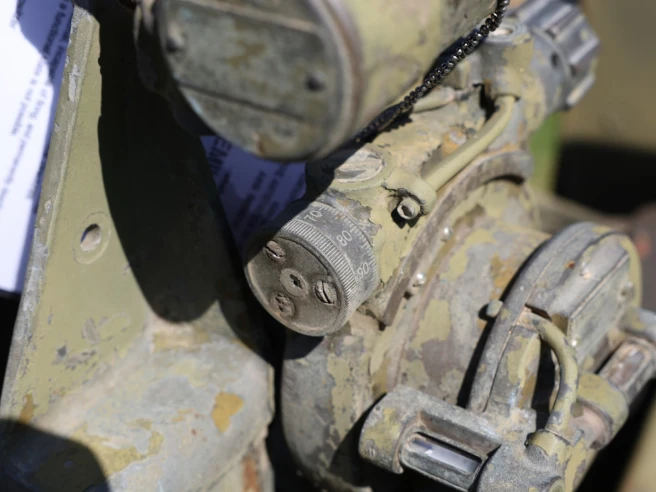

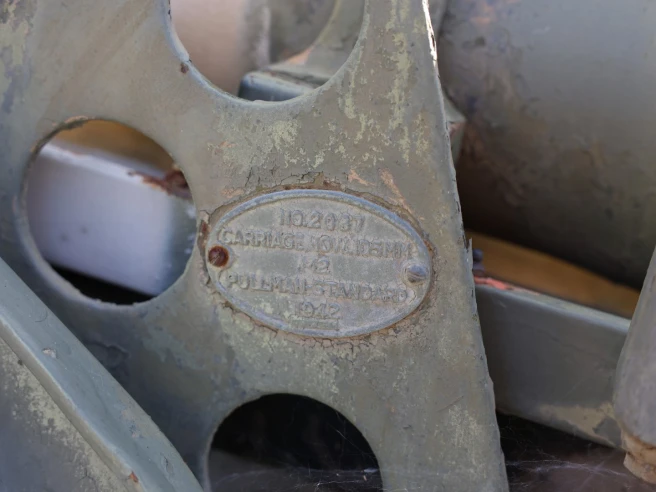


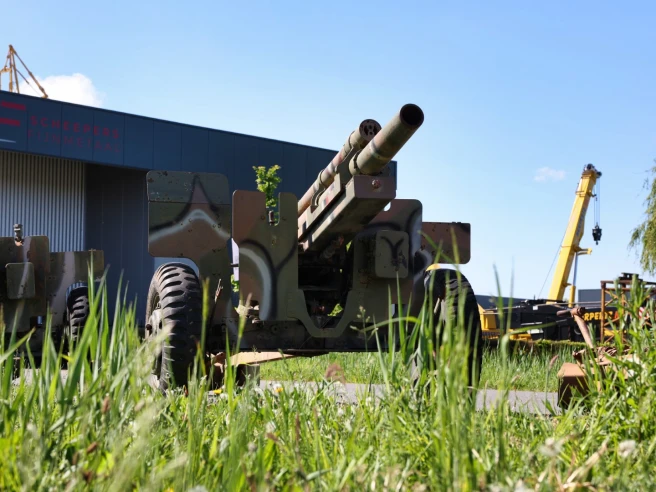
The M2 and M2A1 howitzers were the workhorse field artillery for the U.S. Army in WWII. More than 8,500 were produced during the war.
The M2A1 was the standard light field howitzer in the US Army in World War II. Developed based on German World War I 105mm howitzers, it filled the need for a motor-drawn artillery to replace outdated guns and tactics. With a moderate range, soldiers appreciated its accuracy and powerful punch. Its main purpose was anti-personnel, but it was flexible enough to provide indirect fire as well.
In 1943, a typical infantry division had 54 Howitzers, and an armored division had 54 self-propelled 105mm M7 howitzers commonly called the ‘Priest’.
The howitzer was also mounted in the DUKW, the M3 half-track as the 105mm Howitzer Motor Carriage T19, and in the M4 and M4A3 Sherman tanks.
The initial M2 carriage had electric brakes (which were powered by a small battery located near the rear of the right trail), and the later M2A1 carriage had the brakes removed (though in some instances the battery box might have remained on upgraded M2 carriages).
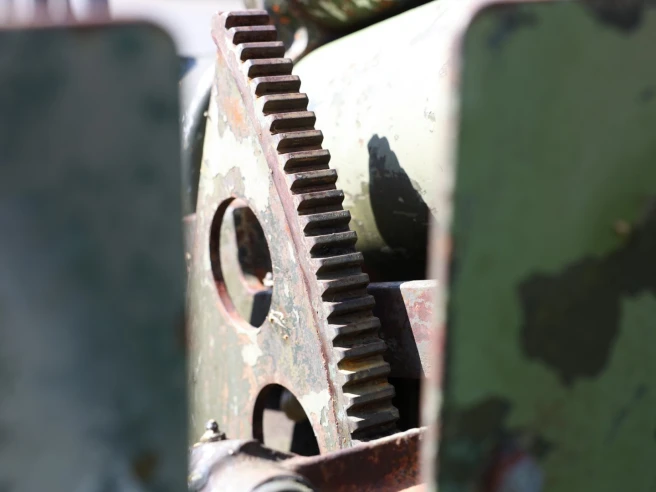
In August 1943 the M2A2 carriage version was introduced with a larger shield and "buffer" mounted, and an enclosed screw traverse mechanism.
One out of every five shells fired by the U.S. Army during the war was a 105 mm “high-explosive” round!
It weighed 42 pounds and was "semi-fixed," meaning it was supplied as a complete round, but the shell could be removed from the case, and the number of the seven propelling charges could be adjusted for range.
The howitzer was manned by a crew of eight and was normally towed by a 6x6 2½ ton truck.
It served in all major theaters of World War II, the Korean War, and the Vietnam War and was purchased by 67 different countries! Therefore, it is without any doubt the most iconic and most popular howitzer of WWII.

