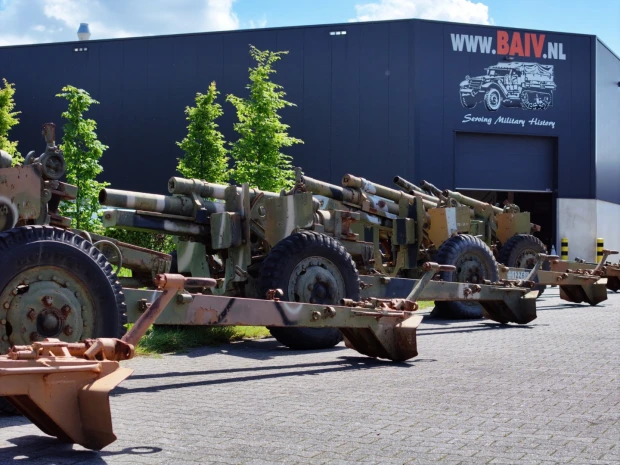
M44 155 mm SPH

155mm howizter

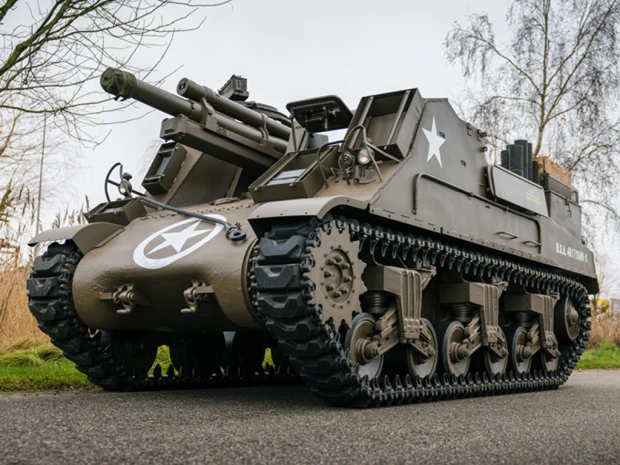
M44 155 mm Self-Propelled Howitzer

Developed after WWII to replace the M41 “Gorilla,” the M44 SPH offered improved mobility and crew safety. Restored to Class-A condition, this rare vehicle represents a key step in post-war U.S. artillery design and honors the legacy of the 2nd Battalion, 20th Artillery Regiment with unit codes and the motto “Deep Strike!” painted on the gun. Restoration began in 2021 and took over a period of 10 months to complete the restoration.

Global timeline

Story of the M44 155 mm SPH

The M44 SPH was a 32-ton, open-topped 155 mm self-propelled howitzer based on the M41 light tank chassis. Powered by a 500 bhp Continental AOSI-895-5 engine, it offered a top speed of 56 km/h and excellent mobility. Armed with the M45 howitzer, it served U.S. and NATO artillery units throughout the 1950s–60s.
1954

Wartime Use / Deployment

Fielded by U.S. and NATO forces; deployed worldwide but developed too late for Korean War combat.

2019

Condition When Discovered

Structurally complete but requiring full restoration of mechanical systems, gun mount, and fittings.

2021

Condition After Restoration

Fully restored, running M44 SPH with complete armament, accurate markings, and museum-grade historical reconstruction.

Highlights

This M44 received a 2,989-hour, 10-month restoration for the National Museum of Military Vehicles, including a complete mechanical rebuild, fully restored 155 mm M45 howitzer, corrected structural features, and historically accurate.

Highlight 1

Full overhaul of running gear, suspension, and Continental AOSI-895-5 powerpack.

Highlight 2

Gun system completely restored: M45 155 mm howitzer with authentic breech and 1956 ordnance components.

Highlight 3

Accurate historical markings added, including “Deep Strike!” motto of the 2nd Battalion, 20th Artillery Regiment dedicated to 2/20 Artillery veterans.

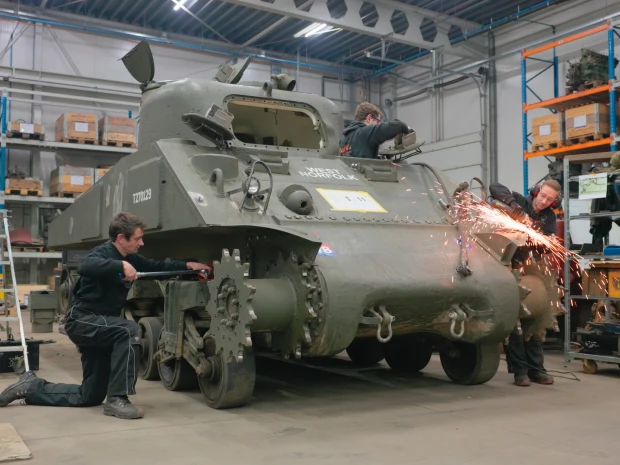
Restoration captured in photos

155mm howizter

Background Story

The M44 155 mm Self-Propelled Howitzer emerged from a post-World War II U.S. Army initiative to modernize field artillery. Its predecessor, the M41 “Gorilla,” lacked protection and crew efficiency.
Early prototypes; the enclosed T99 series, proved unsafe as propellant gases accumulated inside the casemate. When the Korean War triggered a rushed production run, 250 units were built before flaws were fully understood.

Engineers responded by redesigning the vehicle with an open-topped fighting compartment, improved ergonomics, and the new 155 mm M45 howitzer.

This revised model, designated T194 and later standardized as the M44 SPH, entered service in 1954. It combined high mobility, thanks to its powerful 500 bhp Continental AOSI-895-5 engine, with long-range artillery capability.

Although too late for combat in Korea, it became a mainstay of U.S. and NATO Cold War artillery, serving in West Germany, Italy, Turkey, and the United Kingdom, where it was known as the “Cardinal.”

In 2021, the National Museum of Military Vehicles requested BAIV to fully restore an M44 SPH for its artillery collection. Over 2,989 labor hours in ten months, the vehicle underwent a complete mechanical and structural rebuild: engine, driveline, suspension, electrics, hull fittings, and its M45 howitzer were fully restored. The breech assembly; number 1098, built at Watervliet Arsenal in 1956, was also meticulously overhauled. All markings were recreated to honor the 2nd Battalion, 20th Artillery Regiment, including their motto “Deep Strike!” emblazoned on the gun.

Today, this M44 stands as a museum-grade example of early Cold War artillery innovation; technically impressive, historically significant, and restored in tribute to one of the U.S. Army’s most decorated artillery battalions.

It is one of the leading and most iconic vehicles in the running collection of the National Museum of Military Vehicles in Dubois, Wyoming, USA.

Other Restorations

Help keep our shared story alive

Historic military vehicles are more than just a hunk of steel. They represent engineering, craftsmanship, emotion, and an important chapter of our history. Step into the world of historic military vehicles and help us keep this heritage running.